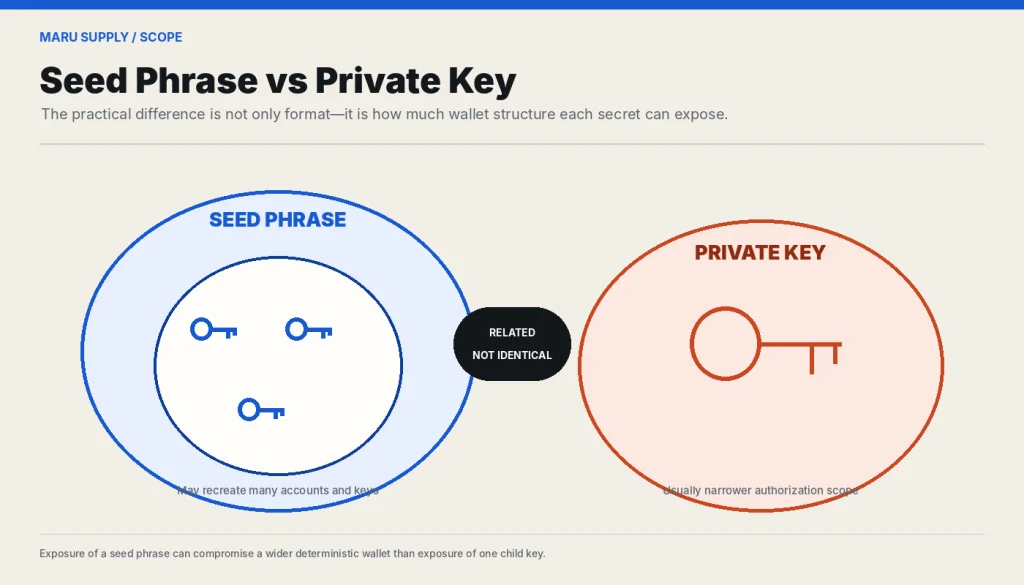
A seed phrase and a private key are related in many deterministic wallets, but they are not the same thing. A BIP39 mnemonic can be converted into a binary seed; an HD wallet following a scheme such as BIP32 can then use that seed to derive a master key and many child private keys. A private key usually controls a particular account, address branch, or spend condition, while the seed phrase may recreate an entire wallet structure.
The difference in one table
| Feature | Seed phrase | Private key |
|---|---|---|
| Form | Ordered human-readable words in a mnemonic backup format. | A secret number represented in a wallet-specific encoding. |
| Typical scope | May recreate many accounts and keys. | Usually authorizes activity for a narrower account or address scope. |
| Main purpose | Backup and deterministic recovery. | Transaction signing or control of an account/output. |
| Safe to share? | No. | No. |
| Can it be replaced? | Only by creating a new wallet and moving assets. | A new key requires moving control to a new address/account. |
| Compatibility concern | Standard, word list, passphrase, derivation path, and network. | Encoding, network, address type, and wallet import support. |
From mnemonic words to wallet keys
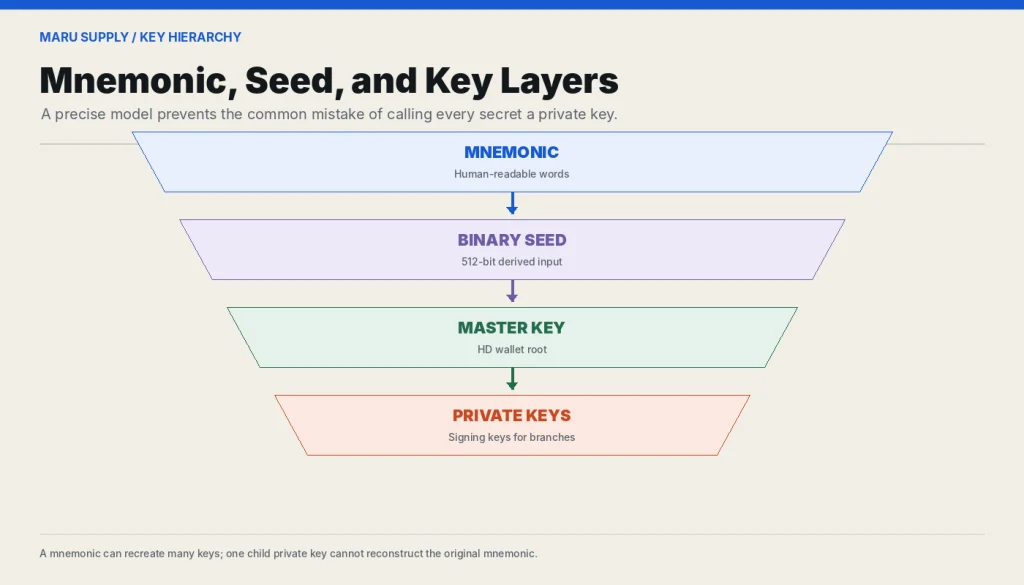
- Mnemonic sentence: the ordered words shown to the user.
- Optional passphrase: an additional BIP39 input, if the user enabled it.
- Binary seed: the 512-bit output of the BIP39 derivation function.
- Master extended key: the root generated by an HD-wallet method such as BIP32.
- Child keys: branches derived for accounts, chains, addresses, or other purposes.
This layered model explains how one backup can restore many addresses without placing every private key on paper. It also explains why a stolen phrase can expose multiple accounts at once.
What is a private key?
A private key is secret cryptographic material used to produce signatures. In Bitcoin, the wallet and signing model uses valid signatures to satisfy spending conditions associated with the relevant public key or script. Other blockchain systems use different account and signature models, but private keys remain sensitive authorization material.
A private key is not normally typed each time a transaction is made. Wallet software or a signing device stores or derives the key and uses it internally.
What is a seed phrase?
A seed phrase is a backup interface for people. BIP39 was designed to encode computer-generated randomness as a mnemonic sentence and then convert that sentence into a seed. It was not designed to turn a memorable user-written quote into a secure wallet.
Do not invent your own phrase
A sentence chosen by a person has predictable patterns and is not equivalent to a properly generated wallet mnemonic. Let reputable wallet software generate recovery material using a secure process.
Why can the same seed show different accounts?
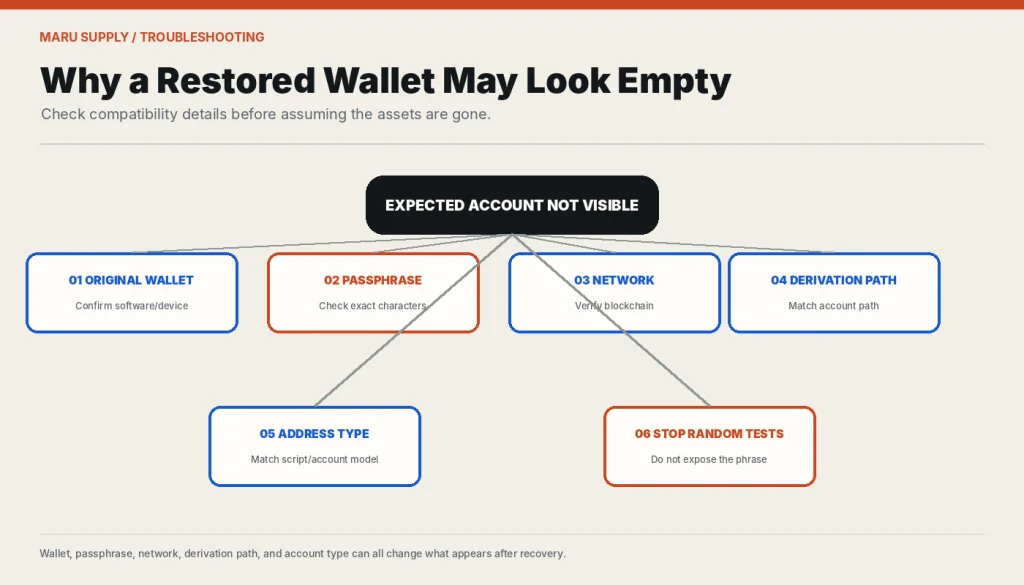
The mnemonic alone may not identify every implementation detail. Wallets can use different derivation paths, script or address types, account indexes, networks, and passphrase settings. If the words restore an empty wallet, do not immediately assume the assets are gone.
- Confirm the original wallet and backup standard.
- Confirm whether an optional passphrase was used.
- Check the intended network and account type.
- Use the original wallet’s documented derivation path or import process.
- Avoid repeatedly entering the phrase into different online tools.
Which secret is more dangerous to expose?
Both are dangerous. A single private key can expose the assets controlled by that key. A seed phrase may expose a much larger deterministic wallet. The practical scope depends on the wallet architecture.
Does changing a password change the private keys?
Usually not. A password or PIN often encrypts local wallet data or unlocks a device. It does not automatically change the seed or derived keys. If the seed or private key has been exposed, generate new secret material in a fresh wallet and move the assets.
How to protect both
- Keep recovery material offline unless the wallet’s verified recovery procedure requires entry.
- Use authentic wallet software and verify transaction details on a trusted display where available.
- Do not paste private keys into portfolio trackers, tax tools, block explorers, or support chats.
- Separate watch-only public information from signing material.
- Test backups using an official recovery-check process before relying on them.
- Move assets to newly generated keys after any credible exposure.
For storage planning, continue to How to Store a Seed Phrase Safely.
For the broader model, review how a seed phrase works and how cryptocurrency wallets manage addresses and signing keys.
Frequently asked questions
Can I derive a seed phrase from one private key?
Normally no. A single child private key does not contain enough information to reconstruct the original mnemonic or the entire HD wallet tree.
Does every private key come from a seed phrase?
No. Keys can be generated independently, imported, or created under standards that do not use BIP39 mnemonics.
Is a seed phrase a master private key?
No. The mnemonic is converted into a seed. An HD-wallet process then derives a master extended key from that seed.
Can I share an extended public key?
An extended public key cannot directly sign transactions, but it can reveal transaction history and addresses, and some derivation structures have additional security implications. Share it only when you understand the privacy and architecture consequences.