A seed phrase is a sequence of words that a compatible cryptocurrency wallet can use to recreate the secret material behind its accounts. The idea did not exist in Bitcoin’s earliest wallets: readers asking when did bitcoin come out are looking at a network that launched in 2009, while the widely used BIP39 mnemonic standard was assigned in 2013. Today, anyone who obtains the correct phrase—and any additional passphrase required by the wallet—may be able to restore the same keys, which is why the phrase must be kept private, offline, and recoverable.
Seed phrase meaning: the quick answer
A seed phrase, also called a recovery phrase or mnemonic phrase, is a human-readable backup created by some cryptocurrency wallets. In a BIP39-compatible wallet, the words encode computer-generated randomness. The wallet converts the mnemonic into a binary seed, and an HD wallet can then derive a tree of keys and addresses from that seed.
The rule that matters most
Never send a seed phrase to support, enter it into an unsolicited website, paste it into a chat, or store it in a screenshot or ordinary cloud note. As official wallet-scam guidance emphasizes, legitimate support does not need the phrase to investigate a transaction or “verify” a wallet.
How does a seed phrase work?
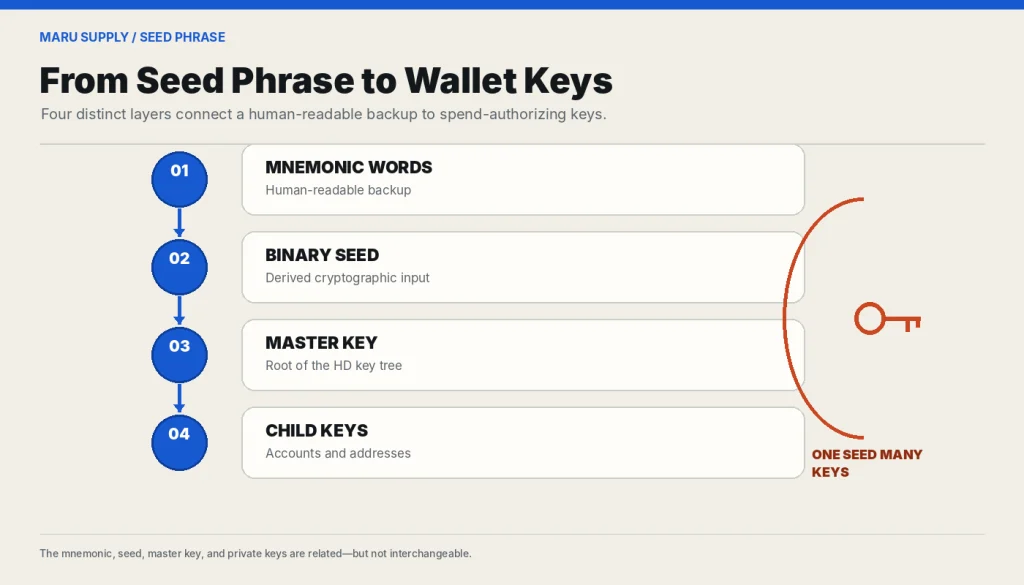
A seed phrase is not a sentence chosen by the user and it is not a readable version of a single private key. In the BIP39 process, wallet software starts with cryptographically generated entropy, adds a checksum, and divides the resulting bit string into 11-bit groups. Each group points to one word in a 2,048-word list.
- Random entropy is generated. For BIP39, the allowed entropy sizes range from 128 to 256 bits in steps of 32 bits.
- A checksum is appended. Its length is the entropy length divided by 32.
- The combined bits become word indexes. Each 11-bit group selects one word from the BIP39 list.
- The mnemonic is converted into a seed. BIP39 uses PBKDF2-HMAC-SHA512 with 2,048 iterations and produces a 512-bit seed.
- An HD wallet derives keys. BIP32 or another deterministic method can use the seed to generate a master key and many child keys.
| Entropy | Checksum | Mnemonic length |
|---|---|---|
| 128 bits | 4 bits | 12 words |
| 160 bits | 5 bits | 15 words |
| 192 bits | 6 bits | 18 words |
| 224 bits | 7 bits | 21 words |
| 256 bits | 8 bits | 24 words |
Twelve and twenty-four words are common, but they are not the only possible backup formats. Some wallets use other standards, such as SLIP39, or product-specific backup systems. Always follow the documentation for the wallet that created the backup.
Seed phrase, binary seed, and private keys are different
These terms describe different layers. Treating them as synonyms makes recovery and compatibility advice less accurate.
| Term | What it is | Why it matters |
|---|---|---|
| Seed phrase / mnemonic | The ordered human-readable words shown by a compatible wallet. | A practical backup that a person can record and re-enter. |
| Optional passphrase | An extra input added during seed generation in BIP39. | A different passphrase produces a different valid seed and wallet. |
| Binary seed | The 512-bit output created from the mnemonic and optional passphrase. | Input for BIP32 or a similar deterministic key system. |
| Master extended key | The root key and chain code produced by an HD wallet. | Starting point for deriving branches of child keys. |
| Private key | A secret value used to authorize a transaction for a corresponding account or output. | Exposure can allow an attacker to control the associated assets. |
A single seed can be used to derive many private keys. This is why backing up one compatible mnemonic can restore multiple accounts, but it is also why exposing that mnemonic can compromise far more than one address.
Why do wallets use seed phrases?
Early wallets could contain many independently generated private keys. A backup might become incomplete after new keys were created. Deterministic wallets improved this model by allowing many keys to be reproduced from one root. A mnemonic makes that root easier for a person to record than a long binary or hexadecimal value.
- Device replacement: a compatible wallet can be restored after a phone, computer, or hardware device is lost or damaged.
- Multiple accounts: one HD root can derive many receiving addresses and account branches.
- Repeatable backup: the same inputs recreate the same deterministic key tree.
- Human transcription: words are easier to copy than raw binary data, although order and spelling still matter.
Is a 24-word seed phrase safer than 12 words?
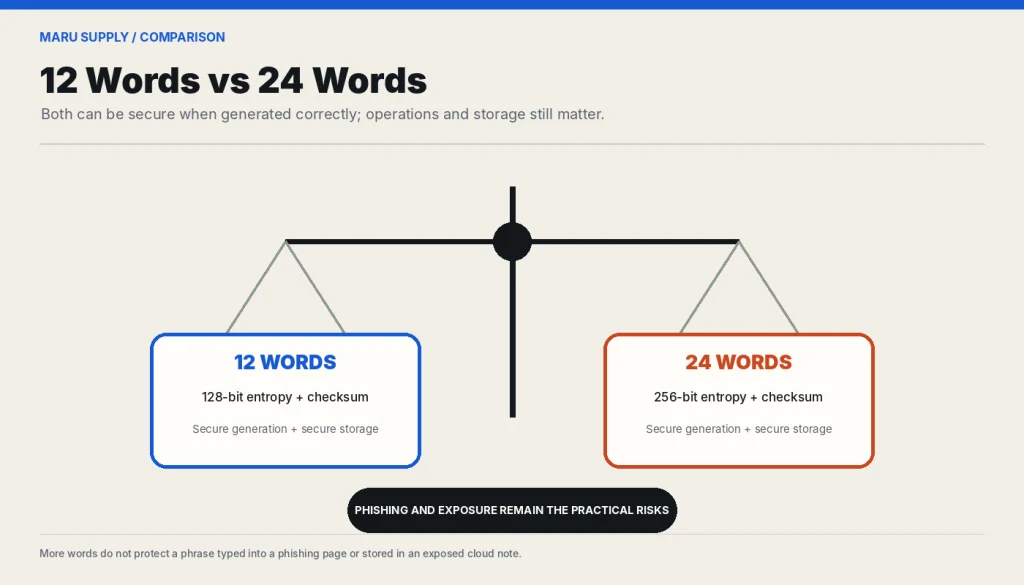
Within BIP39, 12 words normally represent 128 bits of entropy plus a checksum, while 24 words represent 256 bits plus a checksum. Both provide an extremely large search space when generated correctly. In practice, phishing, malware, photographs, cloud backups, weak physical storage, and incorrect recovery procedures are usually more realistic risks than an attacker randomly guessing a properly generated 12-word phrase.
Longer is not automatically better in every operational sense. A longer backup takes more space, creates more opportunities for transcription error, and does not protect a user who types it into a phishing page. Use the format generated by reputable wallet software and protect it correctly.
What is a BIP39 passphrase?
BIP39 allows an optional passphrase, sometimes informally called a “25th word,” although it can contain more than one word and is not selected from the BIP39 word list. The mnemonic and passphrase are combined during seed generation. Every passphrase produces a valid seed, so a typo does not produce an obvious error—it opens a different wallet.
Passphrases add responsibility
A passphrase can reduce the damage caused by a stolen written mnemonic, but losing or mistyping it can make the intended wallet inaccessible. Do not add one until you understand the wallet’s implementation, backup process, and recovery test procedure.
What happens if you lose a seed phrase?
The result depends on whether the wallet is still accessible. If you can still unlock and send from the wallet, the safer response is usually to create a new wallet with a new backup, verify the new receiving address, and transfer the assets. Do not wait for the device to fail.
If the seed phrase is gone and no working wallet, private-key export, or other valid backup remains, a non-custodial provider usually cannot recreate it. That absence of central recovery is part of the self-custody model. See what happens after a seed phrase is lost for a decision-based guide.
What happens if someone steals it?
Treat a revealed seed phrase as compromised even if no funds have moved yet. An attacker may wait, monitor deposits, or use the backup on another compatible wallet. If the wallet is still under your control, create a fresh wallet from a new independently generated seed and move assets after carefully verifying addresses, networks, fees, and any token approvals.
Changing an app password, PIN, email password, or hardware device does not invalidate keys derived from the exposed seed. The new wallet must use new secret material. Read the guide to common seed phrase scams before interacting with anyone offering recovery help.
How should you store a seed phrase?
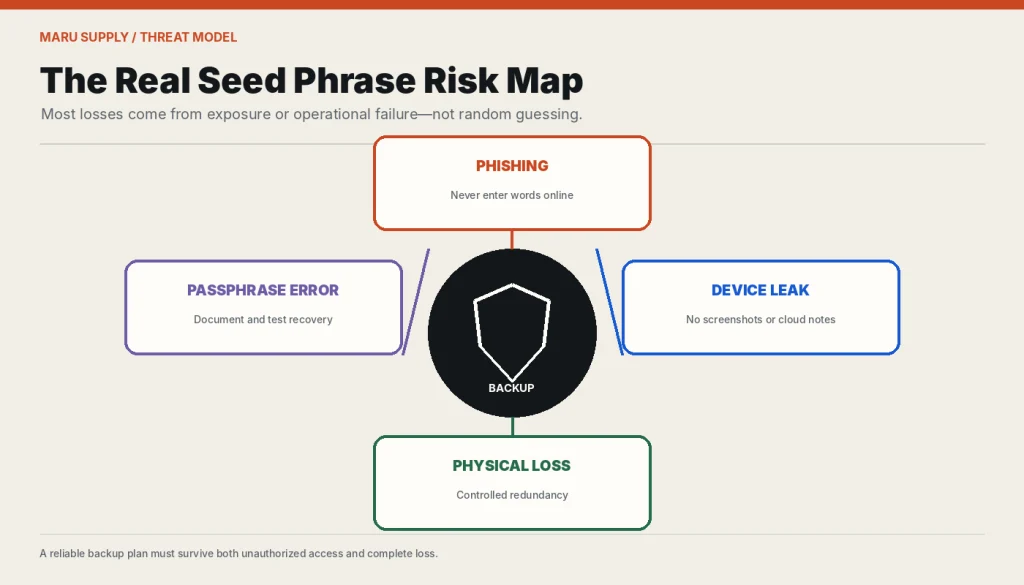
A useful backup must survive both theft and loss. The right method depends on the amount at risk, living situation, disaster exposure, travel, trusted successors, and the wallet’s recovery model. No storage method is risk-free.
- Record the phrase offline in the exact order generated by the wallet.
- Keep it out of photographs, cloud storage, email, messaging apps, shared documents, and ordinary note-taking software.
- Protect it from fire, water, fading, accidental disposal, unauthorized access, and public observation.
- Avoid a single point of failure, but do not create uncontrolled copies.
- Use only the wallet’s official recovery-check procedure and verify software authenticity before entering any words.
- Document enough information to identify the wallet type and recovery standard without writing the phrase in the same document.
The full threat-model approach is covered in How to Store a Seed Phrase Safely.
Common seed phrase mistakes
- Taking a photo: the image may sync automatically, appear in backups, or remain recoverable after deletion.
- Typing it into a website: recovery should happen only in verified wallet software or a trusted device workflow.
- Sending it to support: possession of the phrase is not a normal support requirement.
- Making one fragile copy: paper can be lost, damaged, or discarded.
- Making too many copies: every copy increases the number of places an attacker can find.
- Restoring into an incompatible wallet: the same words may not display the expected accounts if the wallet uses different standards or derivation paths.
- Forgetting an optional passphrase: the mnemonic alone will open a different wallet.
Can any wallet recover the same seed phrase?
No. Compatibility depends on the backup standard, word list, coin support, derivation path, account model, script type, and any optional passphrase. Two wallets can both support BIP39 yet display different accounts until the correct derivation settings are used.
Before an emergency, document the wallet product, version or standard, relevant account types, and the official recovery instructions. Do not test a valuable backup by entering it into random software simply because that software claims BIP39 support.
To place the recovery phrase in its wider technical context, review how a cryptocurrency wallet manages keys, compare a seed phrase with a private key, and examine the practical differences between a hot wallet and a cold wallet.
Frequently asked questions
Is a seed phrase the same as a password?
No. A wallet password or PIN commonly protects access to one app or device. A seed phrase can recreate the underlying wallet keys in compatible software, so changing the app password does not change the seed.
Can a seed phrase be changed?
A deterministic wallet normally keeps the same seed. To replace a compromised or poorly stored phrase, create a new wallet with newly generated secret material and transfer the assets.
Can someone guess a seed phrase?
A correctly generated BIP39 phrase has a very large search space. Random guessing is not the usual practical threat. Phishing, malware, weak generation, exposed backups, and user mistakes are more realistic risks.
Should I memorize my seed phrase?
Memory can supplement a physical backup but should not be the only recovery method. Injury, stress, time, and ordinary forgetting make memory an unreliable single point of failure.
Can customer support recover my seed phrase?
A non-custodial wallet provider normally cannot recreate a seed phrase it never possessed. Any person asking you to reveal the phrase should be treated as a potential scammer.
Is it safe to store a seed phrase in a password manager?
That decision changes the threat model and depends on the password manager, device security, account recovery, encryption, and the value at risk. For high-value self-custody, Bitcoin.org wallet-security guidance and major wallet vendors generally recommend keeping the primary backup offline. Do not treat any digital storage method as risk-free.