Losing a seed phrase does not always mean immediate loss of funds, but the available response depends on what still works. If the original wallet is accessible, move the assets to a newly created wallet before the device or app fails. If the phrase and every usable copy of the wallet are gone, a non-custodial provider usually cannot recreate the missing secret.
First determine what you still have
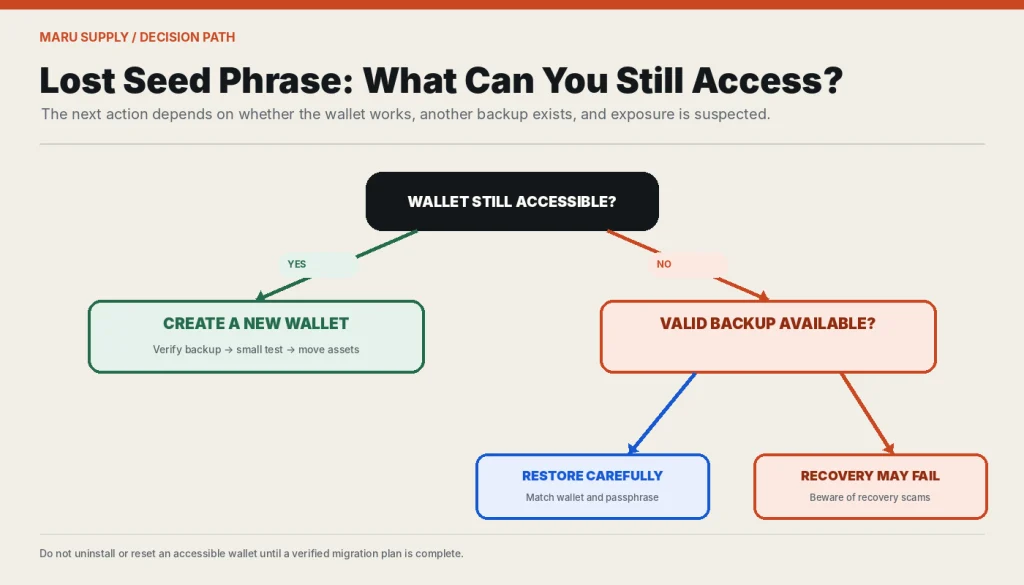
| Situation | Likely next step |
|---|---|
| Wallet opens and can sign transactions | Create a new wallet with a new backup, test it, and transfer assets. |
| Wallet opens but cannot send | Check network, fees, account, device, and official support documentation without revealing secrets. |
| Device is lost but the seed phrase is safe | Restore only through verified compatible wallet software or a replacement device. |
| Seed phrase is lost but another valid backup exists | Verify the backup and plan a move to new secret material if the storage process is unreliable. |
| Only an app password or PIN remains | The password may unlock a local wallet, but it usually cannot recreate deleted key material by itself. |
| No seed, no private keys, no working wallet, no custodial recovery | Recovery may be impossible. |
If the wallet is still accessible
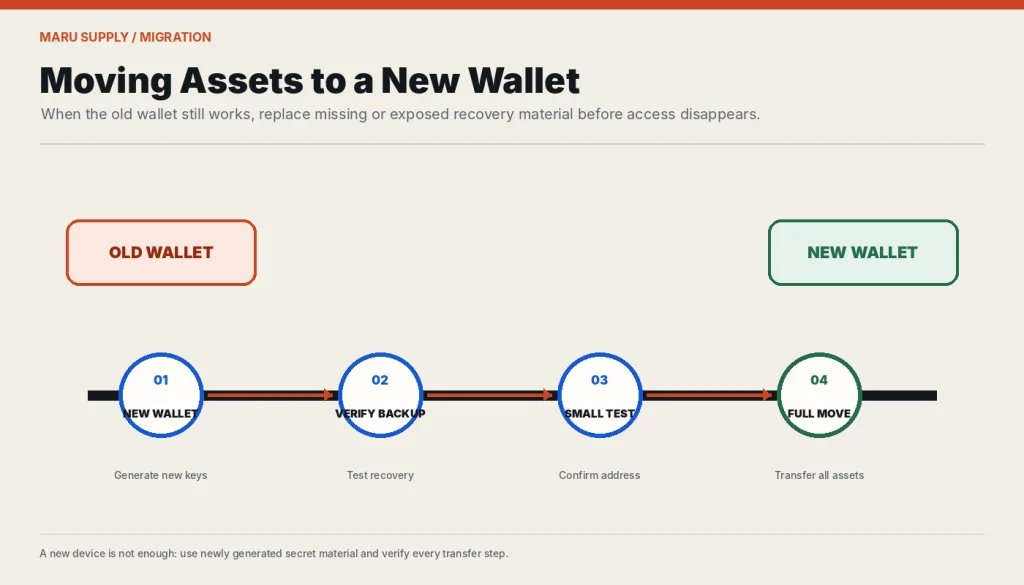
- Do not reset or uninstall it. Avoid updates or changes that could remove access until the situation is understood.
- Create a fresh wallet. Generate a new seed in authentic software or a trusted device and record it correctly.
- Test the new backup. Use the official recovery-check process and a small transfer where appropriate.
- Transfer assets. Verify the network, receiving address, token type, fees, and transaction details.
- Check remaining assets. Include tokens, multiple accounts, staking positions, NFTs, and assets on different networks.
- Retire the old wallet. Do not continue depositing to addresses controlled by a backup you no longer possess.
If the device is lost but the seed phrase is available
A compatible recovery wallet can derive the same keys when the mnemonic, passphrase, derivation settings, and network are correct. Use the original wallet’s official instructions where possible.
- Obtain software or a replacement device from an authentic source.
- Confirm whether the original wallet used BIP39, another standard, or a product-specific backup.
- Confirm whether a passphrase was enabled.
- Restore in a private environment and verify the first expected addresses before moving funds.
- If the original device may have been stolen rather than destroyed, consider moving funds to a completely new wallet after recovery.
If only the wallet password is known
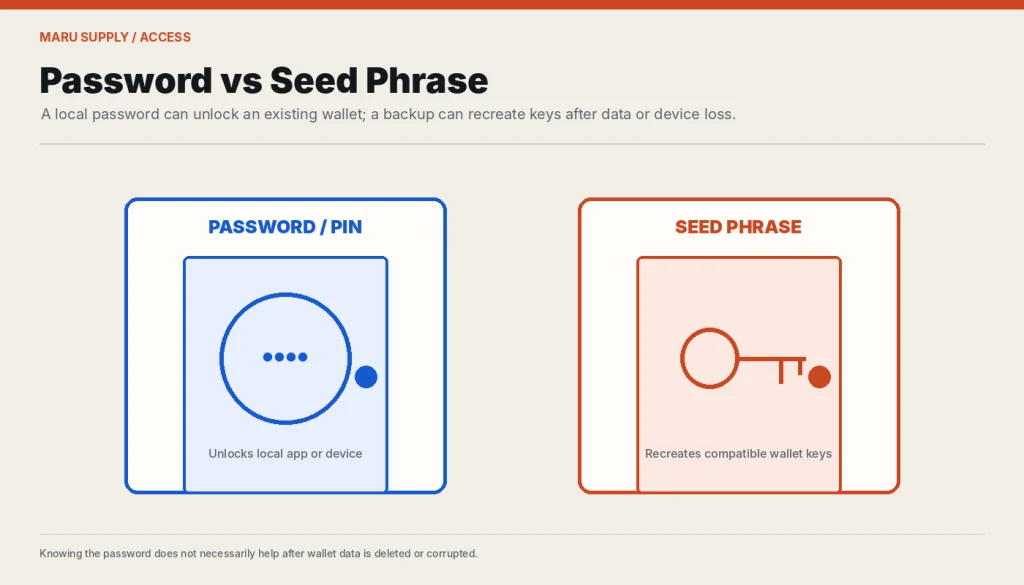
A password or PIN often protects a local app, encrypted file, or device. It is not normally a substitute for the seed phrase. If the app still contains the key material, the password may unlock it. If the wallet data is deleted or corrupted, the password alone may not help.
If one or more words are missing
BIP39 includes a checksum, which can help identify invalid combinations, but attempting to reconstruct a valuable backup is sensitive security work. The number of missing words, known positions, passphrase, derivation path, and device security all affect feasibility.
Be cautious with recovery services
Official phishing guidance warns that a person who receives enough recovery information may also be able to take the funds. Do not send partial phrases, wallet files, passwords, or device images to an unverified stranger.
Custodial accounts are different
An exchange or custodial wallet may offer account recovery through identity verification, email, two-factor authentication, or support procedures because the provider controls the account infrastructure. That is different from recovering a self-custody seed phrase.
Can the wallet company regenerate the phrase?
A properly non-custodial wallet provider normally does not possess the user’s seed phrase; this is consistent with the self-custody boundary described in Bitcoin.org security guidance. This limits central recovery but also means the provider cannot ordinarily disclose the phrase after a breach. Claims such as “support can retrieve it from the blockchain” are false: blockchains do not publish wallet seed phrases.
What if a lost phrase is later found?
If the wallet was replaced because the phrase was missing, continue using the new wallet. The old phrase may still control old addresses, but its storage history is uncertain. Do not assume it is safe simply because it was found.
How to prevent the same problem
- Keep a verified offline backup in a controlled location.
- Document the wallet standard and recovery instructions separately.
- Avoid one copy in one fragile location.
- Do not rely on a device PIN or memory as the only recovery path.
- Review the plan after moving, changing devices, or increasing the balance.
- Read How to Store a Seed Phrase Safely.
For the underlying recovery model, review how a seed phrase recreates wallet keys. If anyone offers urgent recovery help, also check the guide to seed phrase scams and fake support.
Frequently asked questions
Can a seed phrase be recovered from a public address?
No. A public address does not reveal the original mnemonic or private key.
Can blockchain support reverse a transaction after a phrase is stolen?
Public blockchains generally do not have a central support desk that can reverse a valid transaction. Some custodial services may freeze assets within their own systems, but that is separate from protocol-level reversal.
Should I enter a lost phrase into an online checker?
No. A website that receives the words may be able to reconstruct the wallet. Use only verified wallet recovery procedures.
Can I keep using the wallet after finding the old phrase?
You can technically retain access, but if the phrase’s storage history is uncertain, moving to a new wallet is the safer operational choice.
Does reinstalling the app restore the wallet automatically?
Only if the wallet data remains on the device or a valid backup is restored. Reinstallation can remove local data, so do not uninstall an accessible wallet before confirming the recovery plan.