The Bitcoin.org wallet-security guidance distinguishes connected wallet use from offline approaches: a hot wallet uses an internet-capable environment for key management or transaction signing, while a cold-wallet setup keeps signing keys or signing activity offline. Hot wallets prioritize access and convenience. Cold setups reduce some online attack paths but add cost, operational steps, and physical backup responsibilities.
Hot wallet vs cold wallet at a glance
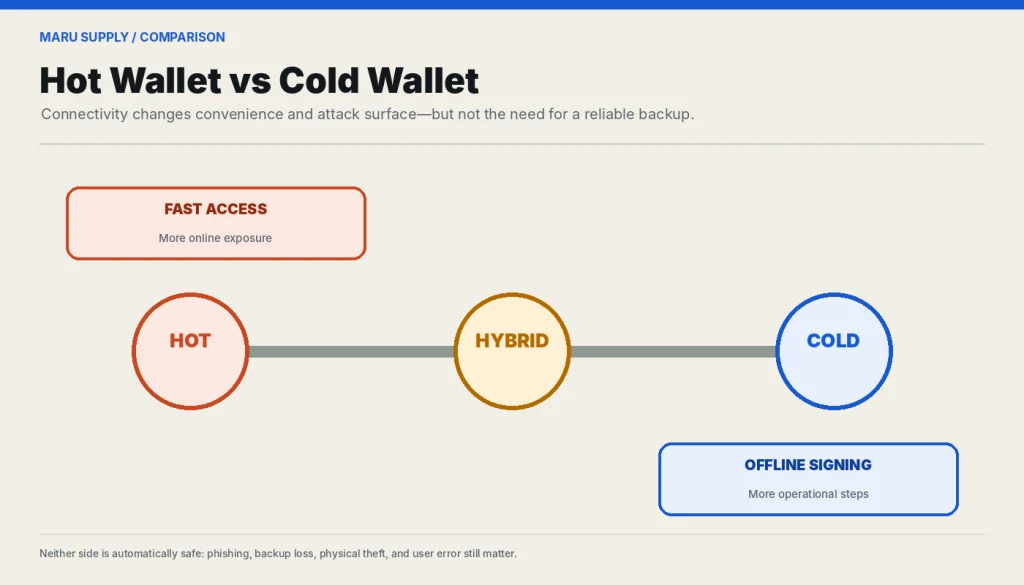
| Criterion | Hot wallet | Cold wallet / offline signing |
|---|---|---|
| Connectivity | Runs on or regularly connects through an internet-capable device. | Keeps sensitive signing activity separated from network access. |
| Convenience | Fast for frequent transfers and web applications. | More steps for setup, verification, and spending. |
| Online attack surface | Higher exposure to malware, phishing, browser, and device compromise. | Reduced when the offline boundary is implemented correctly. |
| Physical risk | Device theft matters, but backup exposure remains critical. | Device and backup theft, damage, or coercion remain important. |
| Cost | Often free software. | May require dedicated hardware or a separate offline device. |
| Best fit | Small active balances and frequent use. | Longer-term or higher-value holdings with less frequent movement. |
What is a hot wallet?
A hot wallet is typically a mobile app, desktop wallet, browser extension, or web-connected service used to create and sign transactions. Its strength is availability: the user can interact with exchanges, decentralized applications, and payment flows quickly.
The same connectivity creates exposure. Malware can target clipboard data, browser sessions, wallet files, transaction details, and recovery material. Phishing can still defeat technically strong cryptography by persuading the user to approve the wrong action.
What is a cold wallet?
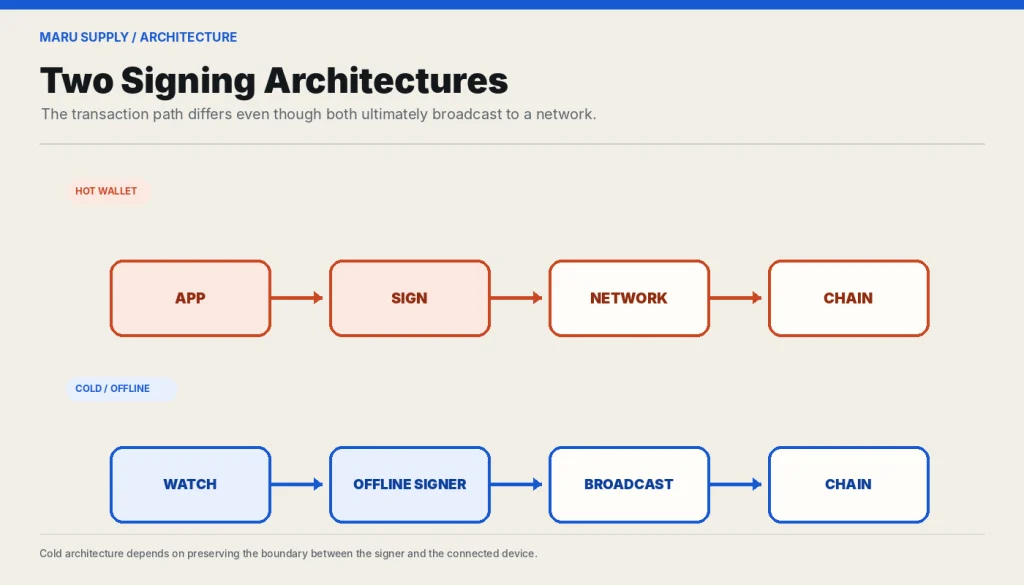
A cold setup keeps the private signing environment away from an internet connection. One example, consistent with the Bitcoin wallet architecture, is an offline computer that signs a transaction prepared on a networked watch-only wallet. Another is a dedicated hardware wallet that stores or derives keys internally and displays transaction details for confirmation.
“Cold” describes an architecture, not a guarantee. A compromised device, fake firmware, poor random generation, exposed seed phrase, malicious transaction, or weak physical storage can still cause loss.
Is a hardware wallet cold storage?
A hardware wallet is commonly used as part of a cold or isolated signing model because private keys are intended to remain inside the device. However, the device still communicates with networked software, so the user must verify transaction details on the device itself and protect the backup.
Security trade-offs
- Malware: hot wallets operate closer to general-purpose software and browser risk.
- Phishing: both types can be harmed if the user reveals a phrase or approves a malicious transaction.
- Physical theft: hardware and offline devices can be stolen; PINs and tamper controls reduce but do not remove risk.
- Backup failure: both models can become unrecoverable if the seed phrase or other backup is lost.
- Supply chain: a dedicated device must come from a trusted source and pass its authenticity checks.
- Operational error: complex offline workflows can lead to wrong addresses, missing assets, or unusable backups.
Which should you use?
Many users benefit from a layered approach rather than one wallet for every purpose.
| Use case | Possible approach |
|---|---|
| Small everyday balance | A reputable hot wallet with device security and limited funds. |
| Frequent web3 interaction | A separate hot wallet that does not hold long-term savings. |
| Long-term holdings | A verified hardware or offline-signing setup with a tested backup. |
| Business treasury | Documented controls, role separation, multisignature or policy-based custody where appropriate, and professional legal/accounting review. |
| Learning and testing | A separate wallet funded with a small amount. |
Backup requirements do not disappear
As official wallet-security documentation notes, a hardware wallet can be lost, damaged, reset, or become unsupported. The recovery backup remains critical. A software wallet can also fail or be deleted. Whichever model you choose, understand what a seed phrase is and how to store it safely.
How to move from a hot wallet to a cold setup
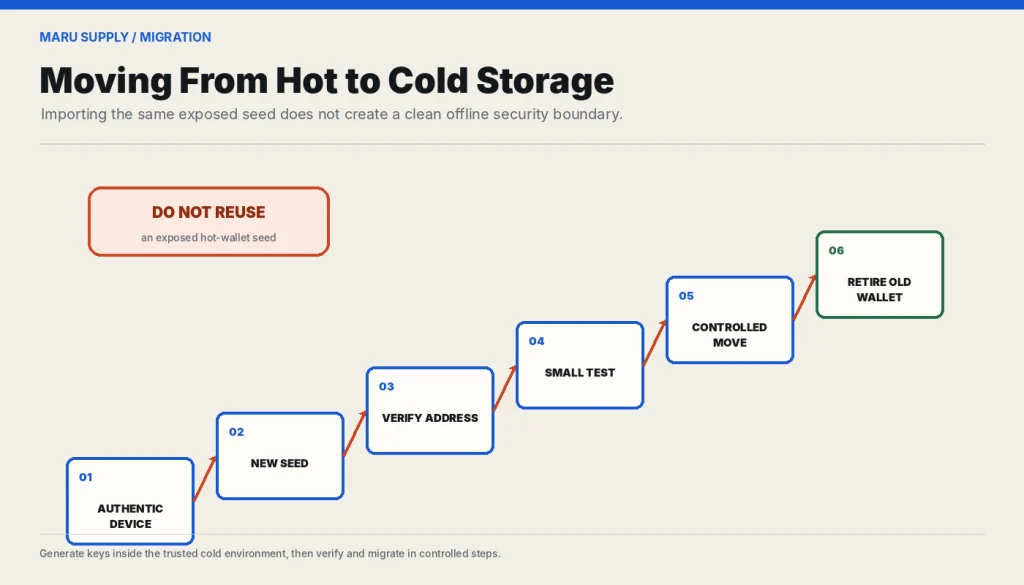
If a seed was generated or entered on an internet-connected device, importing that same seed into a hardware wallet does not erase its prior exposure. For a stronger separation, create a new wallet whose keys are generated within the trusted cold environment and transfer the assets to its verified receiving addresses.
- Initialize the cold setup from an authentic source.
- Record and verify the new backup offline.
- Confirm receiving addresses on the trusted signing device.
- Send a small test transaction.
- Confirm the result on an independent block explorer or node.
- Transfer remaining assets in a controlled sequence.
- Review token approvals and remaining accounts in the old wallet.
Questions to ask before choosing
- How often will the funds move?
- Which networks and assets must the wallet support?
- Can you verify transaction details on a trusted display?
- How will the backup survive theft, fire, water, and time?
- Who needs access and what happens during incapacity?
- Can you test recovery without exposing the seed?
- What is the plan if the vendor or software disappears?
For the wider architecture behind both models, review what a cryptocurrency wallet actually does.
Frequently asked questions
Is a cold wallet impossible to hack?
No. Cold architectures reduce certain online risks but can still fail through exposed backups, compromised devices, malicious transactions, physical theft, supply-chain attacks, or user error.
Should all crypto be kept cold?
That depends on use. A small active balance may be more practical in a hot wallet, while larger or less frequently used holdings may justify stronger isolation.
Is an exchange account a hot wallet?
An exchange may use a combination of hot and cold infrastructure internally, but the customer normally has a custodial account rather than direct control of the provider’s wallet keys.
Does a hardware-wallet PIN replace the seed phrase?
No. The PIN protects access to the device. The seed phrase or other backup is used to recover after loss, damage, or reset.
Can one seed be used in both a hot and cold wallet?
It can sometimes be imported, but entering a cold-generated seed into a hot environment destroys the assurance that it has remained offline.