A cryptocurrency wallet is software, a device, or a coordinated system that manages the keys used to receive assets and authorize blockchain transactions. The wallet does not normally store coins in the same way a physical wallet stores cash; it helps the user control ledger entries associated with particular keys or accounts.
What a crypto wallet actually does
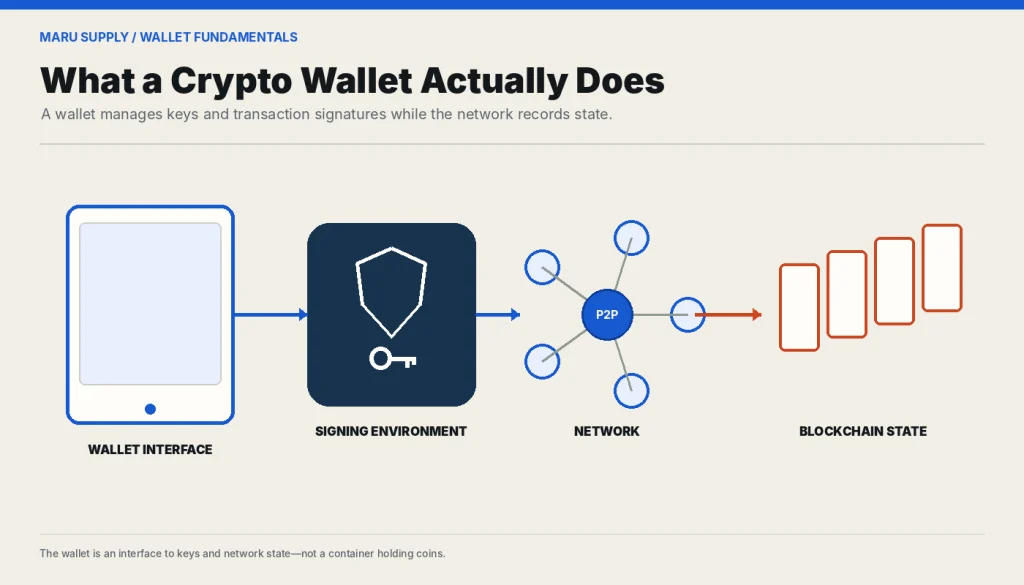
A wallet may generate keys, derive addresses, show balances, prepare transactions, sign them, and broadcast signed data to a network. Those functions can live in one app or be separated across several components.
- Key generation: creates secret values using a secure random process.
- Address generation: derives public information that can be shared to receive assets.
- Signing: uses private keys to authorize a transaction without revealing the keys themselves.
- Network communication: reads blockchain data and broadcasts signed transactions.
- Backup and recovery: provides a way to reproduce or restore keys, often through a seed phrase or another backup format.
Does a wallet hold cryptocurrency?
The phrase “coins in a wallet” is convenient but technically incomplete. As the Bitcoin Developer Guide explains, spendable value in Bitcoin is represented by transaction outputs recorded on the blockchain. Wallet software tracks relevant outputs and uses the corresponding private keys to sign a transaction that spends them.
Other networks may use account balances rather than Bitcoin’s UTXO model, but the core distinction remains useful: the wallet controls credentials and interacts with the ledger; the assets are represented by the network’s state.
Public addresses and private keys
A receiving address is intended to be shared. A private key is secret. The private key is used to create a valid signature, while network participants can verify that signature using related public information.
Address sharing is not seed sharing
A public receiving address can normally be shared to receive a payment. A private key or seed phrase should never be shared for that purpose.
Custodial vs self-custody wallets
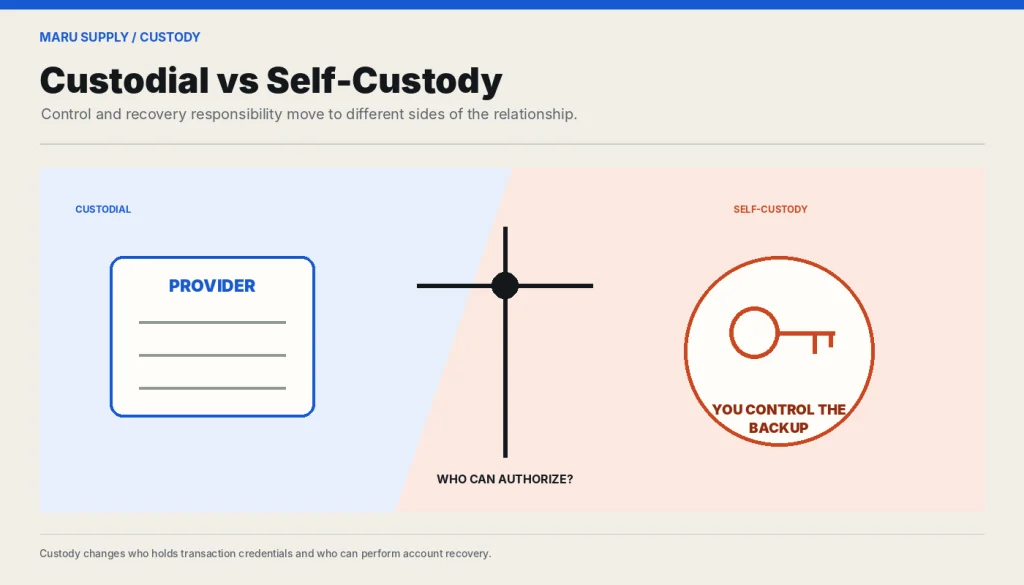
| Question | Custodial service | Self-custody wallet |
|---|---|---|
| Who controls the transaction credentials? | The provider controls at least part of the signing or withdrawal process. | The user controls the relevant keys or recovery material. |
| Account recovery | May use identity checks, email, or provider procedures. | Usually depends on the user’s valid backup and wallet compatibility. |
| Main operational risk | Provider failure, freeze, breach, policy, or account takeover. | Loss, theft, phishing, malware, or incorrect backup handling. |
| User responsibility | Protect account access and evaluate the provider. | Protect keys, backup, device, software, and recovery process. |
Neither model removes risk. Custody shifts important responsibilities to a provider. Self-custody gives the user more direct control but also makes backup and security failures harder to reverse.
Hot, cold, hardware, and watch-only wallets
- Hot wallet: operates on an internet-capable environment and is convenient for frequent use.
- Cold or offline signing setup: keeps signing keys or signing activity away from a networked environment.
- Hardware wallet: a dedicated signing device designed to keep sensitive keys separated from a general-purpose computer or phone.
- Watch-only wallet: monitors addresses and can prepare unsigned transactions without holding the private keys needed to spend.
- Paper backup: a physical record of recovery data; it is not an interactive wallet and carries its own durability and privacy risks.
For a criteria-based comparison, see Hot Wallet vs Cold Wallet.
Where does a seed phrase fit?
Many modern wallets are hierarchical deterministic wallets. Instead of backing up every private key separately, the wallet can derive a tree of keys from a root seed. A BIP39 mnemonic is one possible human-readable method for generating that seed.
The phrase, seed, and keys are different layers. See Seed Phrase vs Private Key for the detailed relationship.
How to choose a wallet
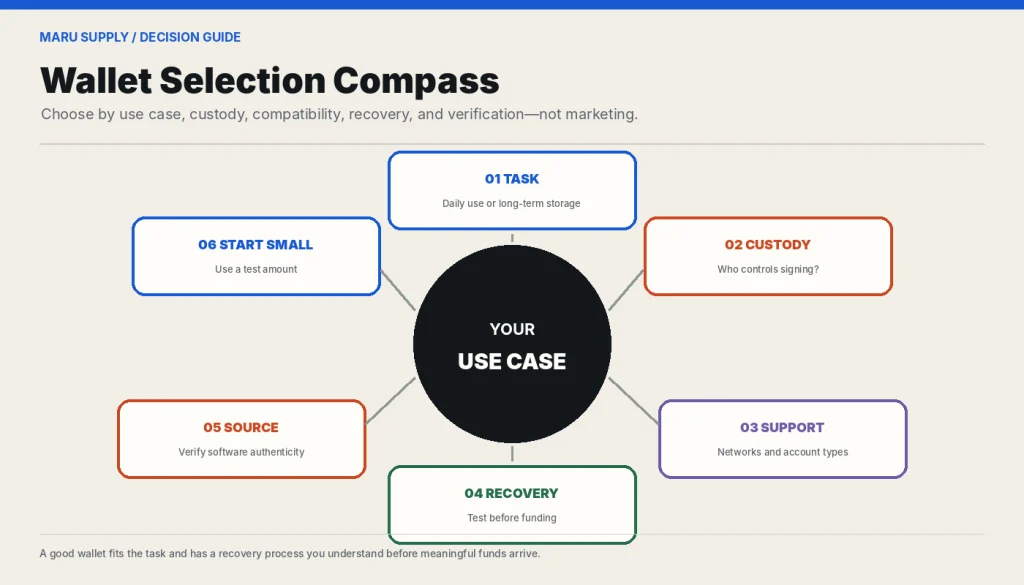
- Define the task. Daily spending, long-term storage, testing a protocol, and business treasury have different requirements.
- Confirm custody. Know who can authorize transactions and what happens if an account or device is lost.
- Check supported networks and assets. A wallet name alone does not guarantee support for every token or account type.
- Review recovery instructions before funding. Know the backup format, optional passphrase behavior, and official recovery process.
- Verify the software source. Use the developer’s official distribution channel and follow documented wallet-security practices when verifying software and devices.
- Start small. Test receiving, sending, fees, address verification, and recovery with an amount you can afford to risk.
- Separate use cases. Consider keeping frequent activity separate from long-term holdings.
Common wallet mistakes
- Installing a fake app or browser extension.
- Assuming a device PIN replaces the need for a backup.
- Entering a seed phrase into a website or support form.
- Sending an asset over an unsupported network.
- Failing to verify the destination address and transaction details.
- Keeping every asset in one environment regardless of use case.
- Importing a previously exposed software-wallet seed into a hardware device and assuming the old keys have become secure.
For a focused explanation of the backup layer, start with what a seed phrase is and how wallet recovery works.
Frequently asked questions
Can a wallet provider take my funds?
In a custodial model, the provider controls important parts of withdrawal or signing. In a self-custody model, the provider should not possess the keys, but malicious or compromised software can still mislead the user or expose secrets.
Is a hardware wallet always cold?
A hardware wallet is designed to isolate signing keys, but the complete setup may still interact with a networked computer. Security depends on the device, firmware, transaction verification, backup, and user behavior.
Can one wallet show accounts from another wallet’s seed phrase?
Sometimes, but only when standards, derivation paths, networks, account types, and any passphrase are compatible. Never test a valuable seed in unknown software.
What happens if the wallet company disappears?
A standards-compatible self-custody backup may be recoverable with other compatible software, but compatibility should be checked before an emergency. Custodial accounts depend more heavily on the provider.